
On this page
- Can You Open a UAE Business Account Without an Emirates ID?
- Route 1: Apply as a Non-Resident
- Route 2: Appoint a UAE-Resident Signatory
- Route 3: Get a UAE Residence Visa Through Your Company
- Company Documents You Will Need
- Extra Documents Banks Ask Non-Resident Owners For
- How Long It Takes
- Step-by-Step Process
- What You Receive When the Account Opens
- Minimum Balance and Monthly Fees, Bank by Bank
- Which Bank Suits a Trading Company Owned From Abroad?
- Which Bank Suits a Service Company Owned From Abroad?
- Common Reasons Non-Resident Applications Are Delayed
- Frequently Asked Questions
Can You Open a UAE Business Account Without an Emirates ID?
Yes, it is possible, but it takes more planning than it does for UAE residents. You can own a UAE mainland or free zone company while living abroad, and some banks will open the company's account even if no owner holds an Emirates ID. Others, particularly for online applications, require at least one authorised signatory or partner who lives in the UAE.
This guide explains your options, the extra documents banks ask non-residents for, how long it takes and what it costs. If you already hold a UAE residence visa and Emirates ID, follow our guide for residents instead.
Important
Many online applications need a UAE-resident signatory
Digital business accounts are usually built for UAE-resident owners. Emirates NBD's online business account application requires at least one UAE-resident signatory, and Mashreq NEOBiz requires at least one partner or power of attorney holder who is a UAE resident. If every owner and signatory lives abroad, you will usually apply through a bank's business banking team instead, and expect a video call or an in-person meeting.
Route 1: Apply as a Non-Resident
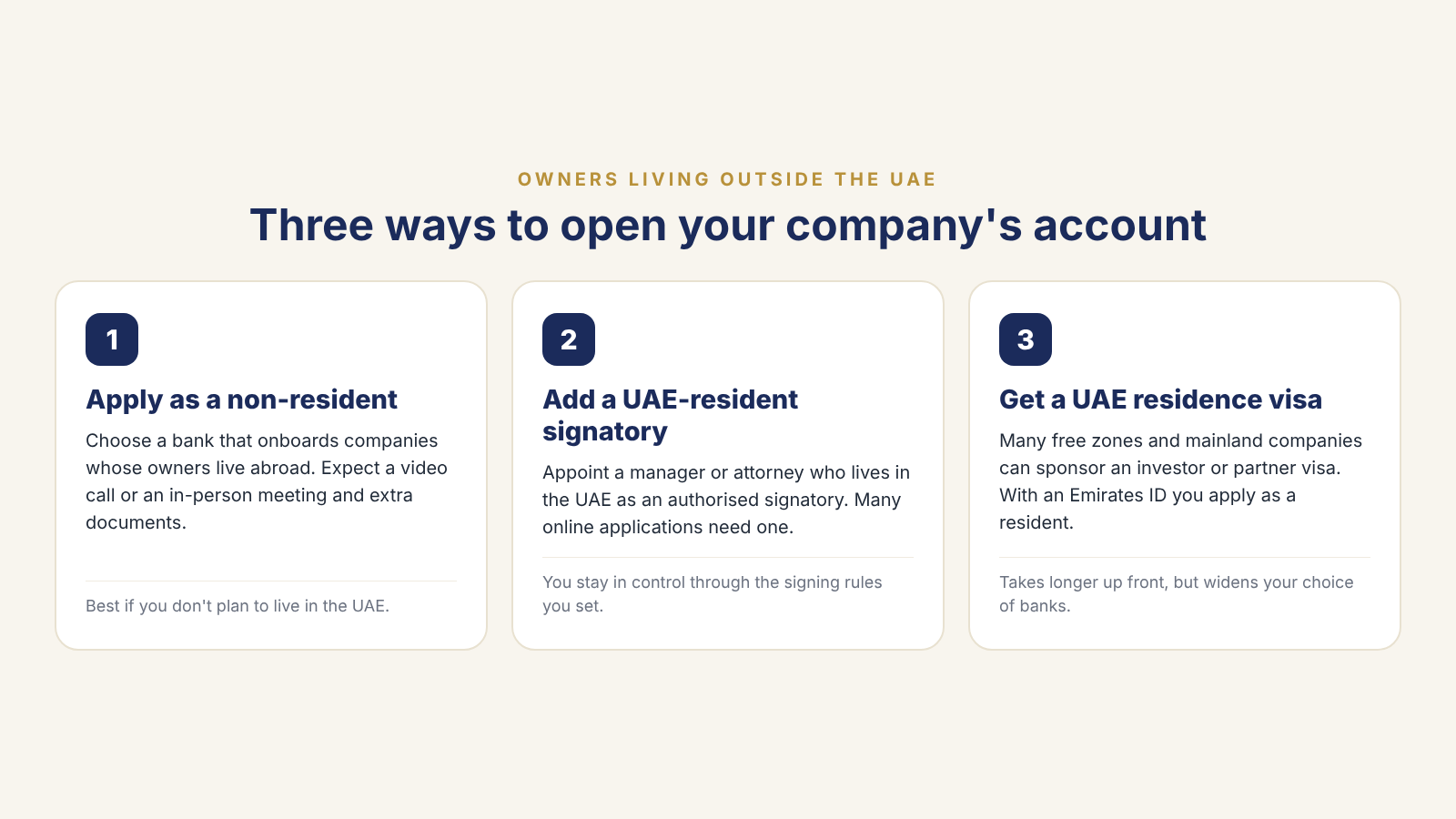
Some banks onboard companies whose owners all live abroad. Expect the bank to verify you by video call or ask you to visit the UAE for an in-person meeting, and to ask for more evidence about you, your source of funds and your business than it would ask a resident. This route suits owners who don't plan to live in the UAE.
Route 2: Appoint a UAE-Resident Signatory
You can appoint a manager, partner or attorney who lives in the UAE and holds an Emirates ID as an authorised signatory, through a board resolution or a power of attorney. This often opens the door to online applications and faster account opening. You stay in control through the signing rules you set, for example requiring your approval for payments above a set amount.
Choose this person carefully, because they can act on the company's account within the authority you give them.
Route 3: Get a UAE Residence Visa Through Your Company
Many free zones and mainland authorities let a company sponsor an investor or partner visa for its owner. Once you have the visa and an Emirates ID, you apply as a UAE resident, with the same choice of banks and accounts as other residents. It adds the visa process, medical test and Emirates ID application before you start, but it is the most flexible long-term route if you will spend time in the UAE.
Company Documents You Will Need
| Trade licence | Valid and in the company's name, mainland or free zone |
|---|---|
| Memorandum and Articles of Association | Including any amendments |
| Certificate of incorporation or registration | Usually issued by free zones and the registry |
| Shareholder register or share certificates | Showing who owns the company |
| Board or shareholder resolution | Approving the account and naming the authorised signatories |
| Ultimate beneficial owner details | Everyone who owns or controls 25% or more |
| Proof of UAE business address | Tenancy contract (Ejari) or free zone lease or flexi-desk agreement |
| Company profile or business plan | What you do, customers, suppliers, countries and expected turnover |
| Foreign corporate shareholders | Their incorporation documents, notarised and attested for use in the UAE |
Extra Documents Banks Ask Non-Resident Owners For
| Passport | Valid copy, with the original shown at verification |
|---|---|
| Proof of residential address abroad | Recent utility bill or bank statement in your name |
| Bank reference letter | From your bank in your home country, where requested |
| Personal bank statements | Usually the last six months |
| Detailed CV | Your professional background and previous businesses |
| Source of funds and wealth | Evidence of where the capital came from, such as savings, a business sale or dividends |
| Tax residency self-certification | The bank's CRS and FATCA form, showing your tax residence country and tax number |
| Evidence of real business | Contracts, invoices, purchase orders or a website, if you have them |
How Long It Takes
The Central Bank's SME Customer Protection Regulation, in force since 13 September 2026, requires banks to open an SME's account within three business days of receiving every document they need, but only where they assess the business as low risk for money laundering. Banks generally carry out more detailed checks where owners live abroad, and the three-day deadline does not apply where those checks require more time.
In practice, allow for document collection, any notarisation or attestation, the bank's video call or meeting and its follow-up questions, which can take several weeks. Starting with complete, consistent documents is the single biggest thing you can do to shorten it. Money you deposit while the review is under way must be kept blocked by the bank until its checks are complete.
Step-by-Step Process
- 1
Decide your route
Decide whether you will apply as a non-resident, appoint a UAE-resident signatory, or get a residence visa first. This decides which banks and which application channels are open to you.
- 2
Prepare and certify your documents
Collect the company documents and the extra personal documents above. Documents issued outside the UAE, such as a foreign company's incorporation papers, usually need to be notarised and attested before a UAE bank will accept them, so start these early.
- 3
Submit the application
Apply through the bank's business banking team or relationship manager, or online if you have a UAE-resident signatory. Explain clearly what the company does, where its customers and suppliers are, and how money will flow through the account.
- 4
Complete the bank's verification
Attend the video call or in-person meeting, and answer follow-up questions promptly. Some banks need the signatory present to collect cards, tokens or a cheque book, so plan a UAE visit if your bank requires it.
- 5
Activate and set up online banking
Once the account is opened, activate online banking, add users and approval limits, and request any foreign currency accounts you need. With online banking set up, you can run the account from abroad.
What You Receive When the Account Opens
| Account number and IBAN | A 23-character UAE IBAN starting with AE, for local and international transfers |
|---|---|
| Online and mobile banking | Administrator access to run the account from anywhere and set approval rules |
| Debit card | Usually for the authorised signatory; some banks issue it only where one person can sign alone |
| Cheque book | Where the bank offers one to your account type |
| Welcome pack | Account confirmation, terms and the schedule of charges |
| Optional extras | Foreign currency accounts, payment links, payroll (WPS) and business cards |
Minimum Balance and Monthly Fees, Bank by Bank
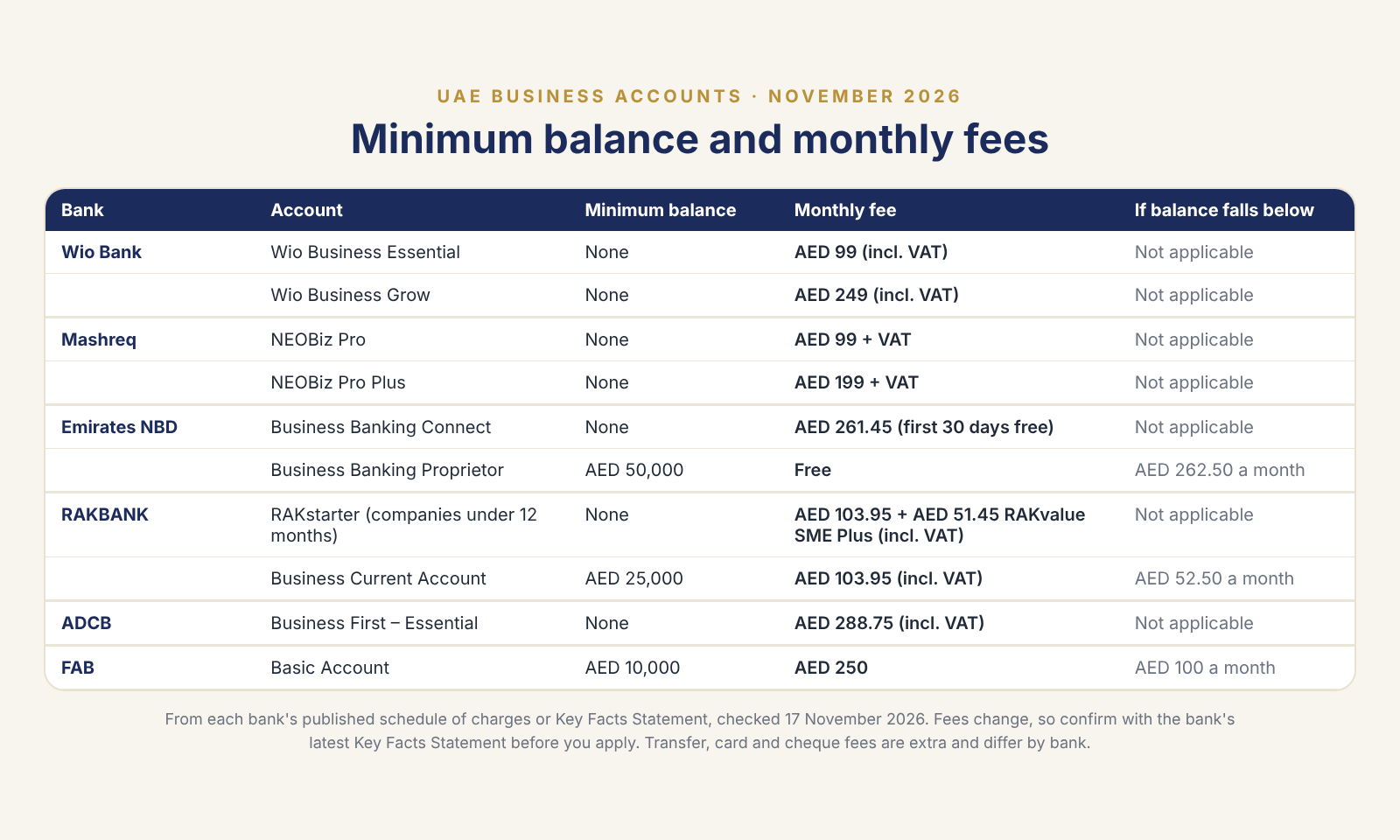
| Wio Business Essential | No minimum balance; AED 99 a month including VAT |
|---|---|
| Wio Business Grow | No minimum balance; AED 249 a month including VAT |
| Mashreq NEOBiz Pro | No minimum balance; AED 99 + VAT a month (needs a UAE-resident partner or attorney) |
| Mashreq NEOBiz Pro Plus | No minimum balance; AED 199 + VAT a month (needs a UAE-resident partner or attorney) |
| Emirates NBD Business Banking Connect | No minimum balance; AED 261.45 a month after the first 30 days |
| Emirates NBD Business Banking Proprietor | AED 50,000 average balance; no monthly fee; AED 262.50 a month if the balance falls below |
| RAKBANK RAKstarter | No minimum balance; AED 103.95 a month plus the RAKvalue SME Plus package at AED 51.45 a month; only for companies under 12 months old |
| RAKBANK Business Current Account | AED 25,000 average balance; AED 103.95 a month; AED 52.50 a month if the balance falls below |
| ADCB Business First Essential | No minimum balance; AED 288.75 a month including VAT |
| FAB Basic Account | AED 10,000 average balance; AED 250 a month; AED 100 a month if the balance falls below |
Important
Fees are only half the question for non-residents
These figures come from each bank's own published schedule of charges or Key Facts Statement, checked on 17 November 2026: Wio Bank (business fees schedule dated 1 January 2025), Mashreq NEOBiz (Key Facts Statement, September 2026), Emirates NBD (business banking schedule of charges, June 2025), RAKBANK (service and price guide, effective 30 September 2026), ADCB (Business First package charges, effective 1 April 2026) and FAB (business fees page). Before comparing prices, first confirm that the bank and account accept your ownership and signatory set-up, because eligibility for non-resident owners differs from bank to bank. Always check the bank's current Key Facts Statement.
Which Bank Suits a Trading Company Owned From Abroad?
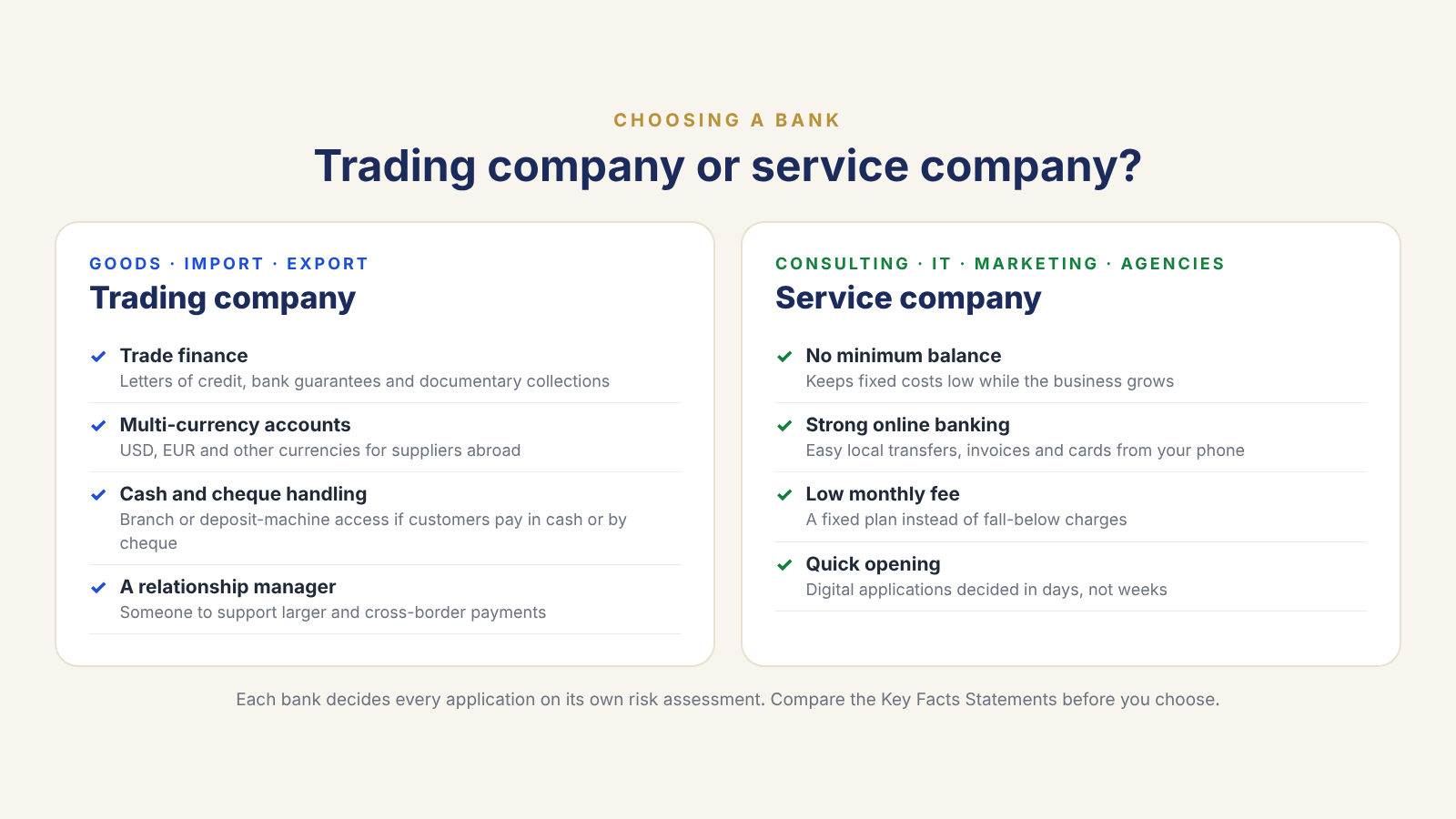
A trading company usually needs trade finance, such as letters of credit and bank guarantees, foreign currency accounts and a relationship manager for cross-border payments. As a non-resident owner, you will usually apply through the business banking team of an established bank with a trade finance desk, such as Emirates NBD, Mashreq, ADCB, FAB or RAKBANK, rather than a digital-only account.
Be ready to show the bank your supply chain in detail: who you buy from, who you sell to, which countries the goods and payments move between, and sample contracts or invoices. Clear trade documents are what make a non-resident trading application succeed.
Which Bank Suits a Service Company Owned From Abroad?
A service company, such as a consultancy, software or marketing business, mainly needs low running costs and good online banking it can operate from anywhere. Accounts with no minimum balance and a flat monthly fee, such as Wio Business, Mashreq NEOBiz or Emirates NBD Business Banking Connect, fit this pattern well, but they are mostly designed for UAE-resident owners or signatories.
If you want one of these accounts, the simplest path is usually to appoint a UAE-resident signatory or take a residence visa through your company. If you will stay fully non-resident, compare the business accounts of banks that accept non-resident owners, and weigh any minimum balance against the monthly fees.
Common Reasons Non-Resident Applications Are Delayed
- No clear explanation of why the company is in the UAE and what it does here
- Foreign documents that are not notarised and attested
- No proof of residential address abroad, or an address that doesn't match other documents
- Source of funds that isn't supported by bank statements or other evidence
- Payments expected to or from high-risk countries without a clear business reason
- Slow replies or missed video calls during the bank's review
Frequently Asked Questions
- Can a non-resident open a UAE business bank account?
- Yes. Some banks open accounts for companies whose owners live abroad, usually with a video call or in-person meeting and more documents. Many online applications require at least one UAE-resident signatory or partner, so check each bank's eligibility first.
- Do I have to travel to the UAE?
- It depends on the bank. Some complete verification by video call, while others ask the signatory to attend a meeting in person or to collect cards and tokens. Ask the bank before you apply so you can plan a visit if needed.
- Can I open the account without any UAE resident involved?
- Yes, at banks that onboard non-resident owners, but your choice of banks and accounts is narrower. Appointing a UAE-resident signatory or getting a residence visa through your company widens your options.
- Will getting a UAE residence visa make it easier?
- Usually, yes. With a residence visa and Emirates ID you apply as a resident, which opens digital accounts and online applications that require a UAE-resident signatory.
- How long does it take for a non-resident?
- The Central Bank's three-business-day deadline applies only to businesses a bank assesses as low risk with complete documents. Applications with owners abroad usually go through more detailed checks, so allow several weeks, including time to notarise and attest any foreign documents.
- Can I run the account from abroad once it is open?
- Yes. Once online banking is set up, you can make and approve payments from anywhere. Keep the bank's records up to date when your passport, address or documents change, or the bank may restrict the account.
- Will the bank report my account to my home country's tax authority?
- Possibly. The UAE takes part in the Common Reporting Standard, which is why banks ask owners and controlling persons to self-certify their tax residence. Information about accounts held for tax residents of other participating countries can be exchanged with those countries' tax authorities.
- Does a UAE bank account make my company UAE tax resident?
- No. A bank account doesn't decide tax residence on its own. A UAE company is generally a UAE tax resident for Corporate Tax, and it must still register for Corporate Tax and file returns whether its owners live in the UAE or abroad.
Own a UAE company from abroad?
Marifah Tax Advisory helps non-resident owners choose a bank that accepts their set-up, prepare the documents and business profile banks ask for, and keep the company compliant with VAT and Corporate Tax. Book a free consultation to get started.