
On this page
- Who This Guide Is For
- Company Documents You Will Need
- Documents for Each Owner and Signatory
- What the Bank Will Ask About Your Business
- Step-by-Step Process
- What You Receive When the Account Opens
- Minimum Balance and Monthly Fees, Bank by Bank
- Which Bank Suits a Trading Company?
- Which Bank Suits a Service Company?
- Common Reasons Applications Are Delayed or Declined
- Frequently Asked Questions
Who This Guide Is For
This guide is for owners and managers of a UAE company, mainland or free zone, who live in the UAE and hold an Emirates ID and residence visa. If you, your partners or your signatories live outside the UAE, read our companion guide for non-residents instead, because the documents and the route are different.
A business bank account is opened in your company's name, not your own. You need it to receive payments from customers, pay suppliers and salaries, and pay VAT and Corporate Tax to the Federal Tax Authority. Keeping business money out of your personal account also makes your bookkeeping, audit and tax returns far simpler.
Important
New from 13 September 2026: a 3-business-day deadline for low-risk SMEs
Under the Central Bank's SME Customer Protection Regulation (Circular No. 2/2026), banks must open an SME's account within three business days once the business has submitted every document the bank needs, provided the bank assesses it as low risk for money laundering. If there is another valid reason for delay, the bank can open the account with restrictions and give you the account number, but the delay must not exceed two weeks. Banks can still take longer where their financial crime checks require it.
Company Documents You Will Need
| Trade licence | Valid and in the company's name, mainland or free zone |
|---|---|
| Memorandum and Articles of Association | Including any amendments (not needed for a sole establishment) |
| Certificate of incorporation or registration | Usually issued by free zones and the registry |
| Shareholder register or share certificates | Showing who owns the company |
| Board or shareholder resolution | Approving the account and naming the authorised signatories |
| Ultimate beneficial owner details | Everyone who owns or controls 25% or more |
| Proof of business address | Tenancy contract (Ejari) or free zone lease or flexi-desk agreement |
| Company profile or business plan | What you do, your customers, suppliers and expected turnover |
Documents for Each Owner and Signatory
| Passport | Valid copy, shown in original at verification |
|---|---|
| Emirates ID | Front and back, valid |
| UAE residence visa | Copy of the visa page or e-visa |
| Proof of residential address | Tenancy contract or recent utility bill |
| Short CV or profile | Especially for new companies with no trading history |
| Source of funds | Where the starting capital came from, such as savings or the sale of a business |
| Tax residency self-certification | The bank's own CRS and FATCA form |
What the Bank Will Ask About Your Business
Banks must understand how you will use the account before they open it. Expect questions about the activity on your licence and what you actually do, your expected monthly turnover and number of transactions, which countries you will send money to and receive it from, your main customers and suppliers, and whether you will handle cash.
The more specific your answers, the faster the review. Invoices, signed contracts, purchase orders or a working website all help, particularly for a new company. Your answers should match your trade licence: an activity the bank cannot see on the licence is a common reason for questions and delay.
Step-by-Step Process
- 1
Choose the bank and account
Compare the minimum balance, monthly fee and services you actually need, using the table further down this guide. A trading company usually needs trade finance and foreign currency accounts, while a service company usually values low fees and good online banking. Ask the bank for its Key Facts Statement; under the Central Bank's rules it must give you one before you sign up.
- 2
Prepare your documents
Gather the company and personal documents listed above, make sure every one is valid and in date, and check that names and passport numbers match across all of them. Scan them clearly in colour. Expired documents and spelling differences between documents are among the most common causes of delay.
- 3
Apply online or at a branch
Most banks now let UAE residents apply online or through an app for a business account, often with a relationship manager following up. You upload the documents, answer the business questions and sign the account forms electronically or in person.
- 4
Verification and compliance review
The bank checks your documents against the originals, verifies your identity, may visit or call your office, and runs its anti-money-laundering and sanctions checks. It may ask follow-up questions or for extra documents. Answer quickly, because the 3-business-day deadline only runs once the bank has everything it needs.
- 5
Account opening and activation
Once approved, the bank opens the account and sends your welcome details. You can deposit funds while the review is still being completed, but the bank must keep them blocked until all its checks are finished, and it has to tell you this in writing.
What You Receive When the Account Opens
| Account number and IBAN | A 23-character UAE IBAN starting with AE, used for all local and international transfers |
|---|---|
| Online and mobile banking | An administrator login so you can add users and set approval rules |
| Debit card | For the authorised signatory; some banks issue one only where a single person can sign |
| Cheque book | The first one is often free; ask if you will pay suppliers or rent by cheque |
| Welcome pack | Account confirmation and terms, plus the bank's schedule of charges |
| Optional extras | Foreign currency accounts, payment links and card terminals, payroll (WPS) and business cards |
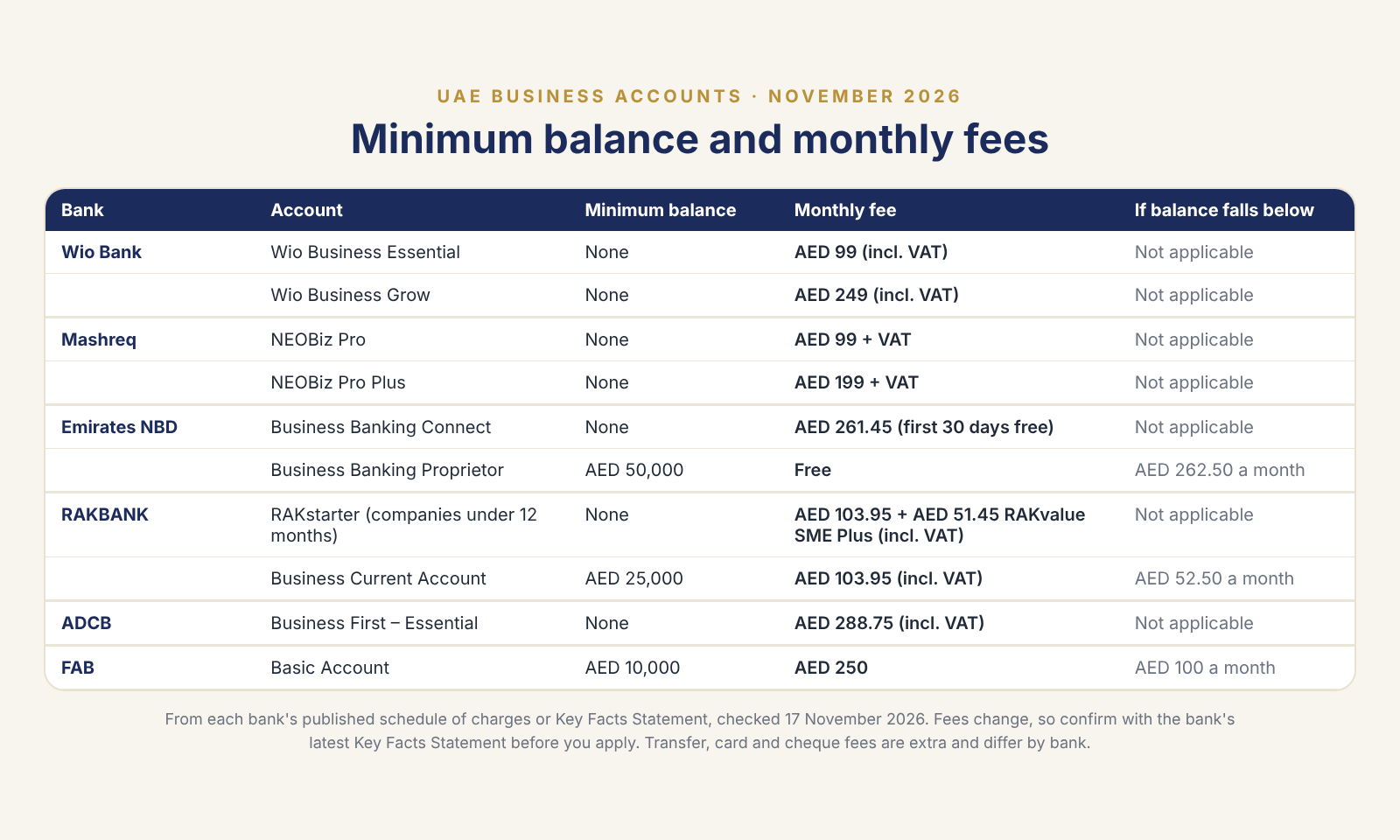
Minimum Balance and Monthly Fees, Bank by Bank
| Wio Business Essential | No minimum balance; AED 99 a month including VAT |
|---|---|
| Wio Business Grow | No minimum balance; AED 249 a month including VAT |
| Mashreq NEOBiz Pro | No minimum balance; AED 99 + VAT a month |
| Mashreq NEOBiz Pro Plus | No minimum balance; AED 199 + VAT a month |
| Emirates NBD Business Banking Connect | No minimum balance; AED 261.45 a month after the first 30 days |
| Emirates NBD Business Banking Proprietor | AED 50,000 average balance; no monthly fee; AED 262.50 a month if the balance falls below |
| RAKBANK RAKstarter | No minimum balance; AED 103.95 a month plus the RAKvalue SME Plus package at AED 51.45 a month; only for companies under 12 months old |
| RAKBANK Business Current Account | AED 25,000 average balance; AED 103.95 a month; AED 52.50 a month if the balance falls below |
| ADCB Business First Essential | No minimum balance; AED 288.75 a month including VAT |
| FAB Basic Account | AED 10,000 average balance; AED 250 a month; AED 100 a month if the balance falls below |
Important
Check the bank's latest Key Facts Statement before you apply
These figures come from each bank's own published schedule of charges or Key Facts Statement, checked on 17 November 2026: Wio Bank (business fees schedule dated 1 January 2025), Mashreq NEOBiz (Key Facts Statement, September 2026), Emirates NBD (business banking schedule of charges, June 2025), RAKBANK (business banking service and price guide, effective 30 September 2026), ADCB (Business First package charges, effective 1 April 2026) and FAB (business fees page). Banks change their fees, and transfer, card, cheque and teller charges are extra. The bank's current Key Facts Statement is always the final word.
Which Bank Suits a Trading Company?
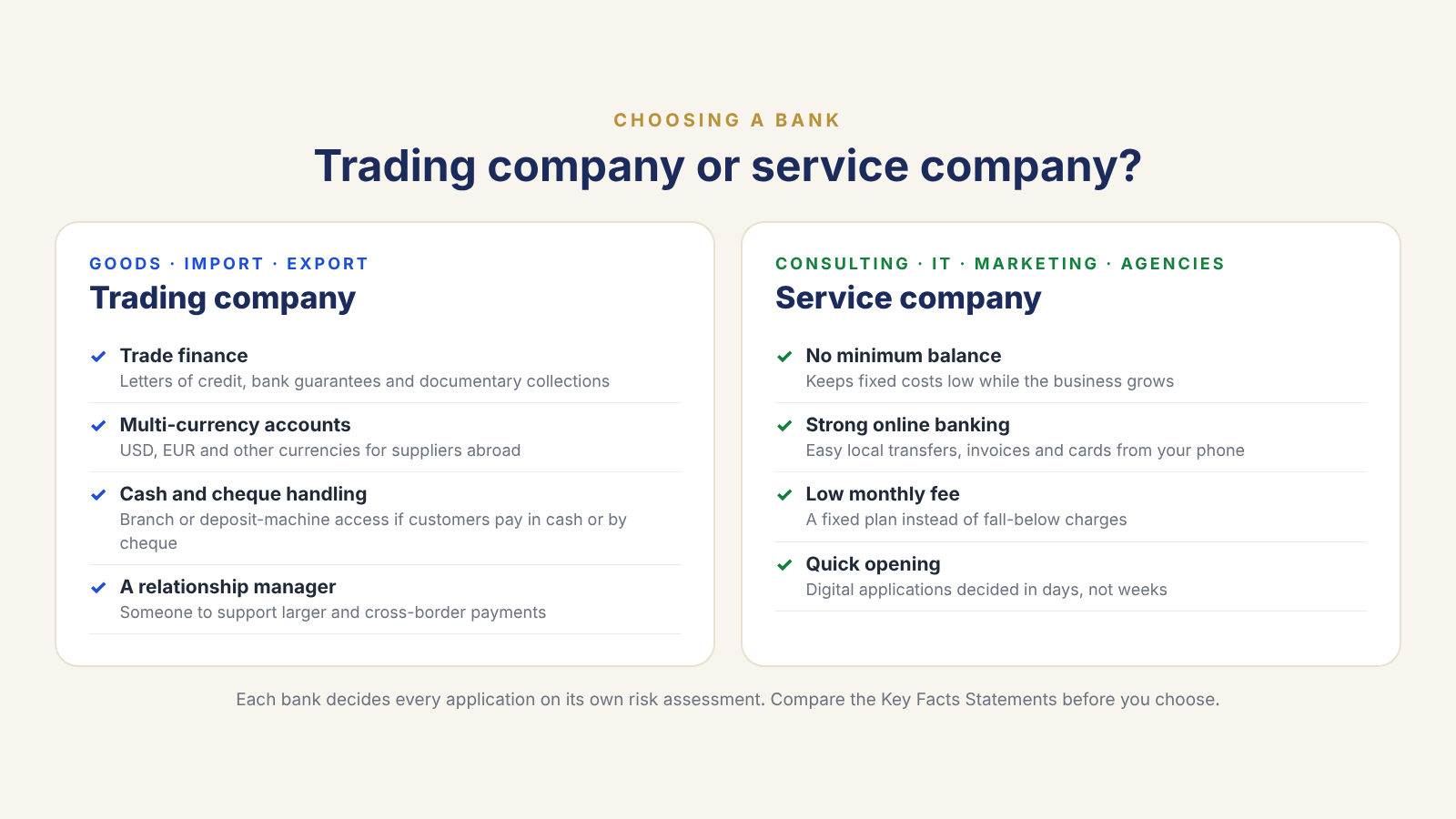
A trading company buys and sells goods, often across borders. It usually needs trade finance, such as letters of credit, bank guarantees and documentary collections, foreign currency accounts in USD or EUR for overseas suppliers, and branch or deposit-machine access if customers pay in cash or by cheque.
A relationship manager who understands your supply chain makes larger and international payments much smoother. Those needs are usually best served by the business banking teams of established banks with trade finance desks, such as Emirates NBD, Mashreq, ADCB, FAB and RAKBANK, on a package that includes a relationship manager.
Expect a minimum balance requirement on most of these packages. For a newly formed trading company, RAKBANK's RAKstarter, which offers AED, USD, EUR and GBP accounts with no minimum balance, is worth comparing. Mashreq's NEOBiz accounts are designed for businesses with turnover of up to AED 100 million that are fully owned by individuals.
Which Bank Suits a Service Company?
A consultancy, IT, marketing or other service business mostly receives and sends local and international transfers and pays by card. It rarely needs trade finance or cash handling, so a low fixed monthly cost and good online banking matter most. Accounts with no minimum balance and a flat monthly fee are usually the best fit: Wio Business Essential (AED 99 a month), Mashreq NEOBiz Pro (AED 99 + VAT), RAKBANK RAKstarter for companies under 12 months old, or Emirates NBD Business Banking Connect.
If your balance will regularly stay high, a balance-based package with no monthly fee, such as Emirates NBD Proprietor, can work out cheaper.
Common Reasons Applications Are Delayed or Declined
- The activity you describe is not on your trade licence
- Expired, unclear or inconsistent documents, such as names spelled differently
- No clear source of funds or explanation of the business model
- Payments expected to or from high-risk countries without a clear business reason
- No real business address, or the bank cannot reach the office or signatory
- Ownership through layers of companies without full ownership documents
- Slow replies to the bank's follow-up questions
Frequently Asked Questions
- How long does it take to open a business bank account in the UAE?
- From 13 September 2026, banks must open a low-risk SME's account within three business days of receiving all the documents and information they need. Where there is a valid delay, the account can be opened with restrictions, but the delay must not exceed two weeks. Accounts that need extra financial crime checks can take longer.
- Do I need a minimum balance?
- It depends on the account. Wio Business, Mashreq NEOBiz Pro, Emirates NBD Business Banking Connect, RAKBANK RAKstarter and ADCB Business First Essential have no minimum balance but charge a monthly fee. Others, such as Emirates NBD Proprietor (AED 50,000), RAKBANK's Business Current Account (AED 25,000) and FAB's Basic Account (AED 10,000), require an average balance and charge a fee if you fall below it.
- Can a free zone company open an account with any UAE bank?
- Yes. Free zone and mainland companies can apply to any UAE bank. Each bank decides on its own risk assessment, and a trade licence does not guarantee approval.
- Can I open the account before my company has started trading?
- Yes. Most companies open their account soon after receiving their licence. Without trading history, a clear business plan, your CV and proof of where the starting capital came from become more important.
- Do I need to visit the bank in person?
- Many banks now let UAE residents apply online, and some complete verification digitally. Others ask the signatory to visit a branch or meet a relationship manager, especially for larger or more complex businesses.
- What is an IBAN?
- Your International Bank Account Number. UAE IBANs are 23 characters long and start with AE. You need it to receive payments, set up payroll and pay the Federal Tax Authority.
- Can the bank charge me to close the account?
- Under the Central Bank's SME rules, a bank cannot charge a closing fee once the account has been open for six months or more. Several banks charge a closing fee in the first six months.
- Can I keep using my personal account for the business?
- It isn't recommended. A company is a separate legal person, and mixing personal and business money makes bookkeeping, audits, VAT and Corporate Tax returns much harder. Customers and suppliers also expect to pay a company account.
Need help opening your company's bank account?
Marifah Tax Advisory helps UAE businesses choose a suitable bank, prepare the documents and business profile banks ask for, and set up bookkeeping, VAT and Corporate Tax from day one. Book a free consultation to get started.